Category Engenharia Mecânica

Trends in Online Casino Gaming: The Rise of the Kiwis

Imagine stepping into a vibrant, bustling online casino from the comfort of your own home. The sound of spinning reels, the thrill of placing bets, and the allure of potential wins fill the air. This is not a scene from an extravagant Las Vegas strip but rather a new reality for many Kiwis embracing online gaming in 2026. In this article, we delve into the latest trends within the New Zealand online casino market, player behaviours, and essential statistics that shape this dynamic landscape.

The world of online gaming is evolving at an unprecedented pace. With increasing accessibility and a wide range of options available, players are becoming more discerning about their choices. The emergence of platforms like true fortune casino reflects these changes, offering tailored experiences that resonate with local tastes and preferences. However, as competition intensifies and player expectations rise, understanding the underlying challenges becomes crucial for stakeholders in this industry.

The Problem: Adapting to Changing Player Preferences

The core challenge within the New Zealand online gaming sector lies in keeping up with shifting player preferences. Recent surveys indicate that over 70% of players seek innovative gaming experiences that offer both entertainment and social interaction. Traditional offerings no longer suffice; players demand immersive environments where they can connect with others while enjoying their favourite games.

Furthermore, regulatory changes have introduced both opportunities and complexities. As authorities strive to protect consumers while fostering a thriving industry, operators must navigate these regulations effectively to ensure compliance without stifling innovation.

Step-by-Step Solution: Embracing Innovation

To address these challenges head-on, organizations must implement targeted strategies aimed at enhancing player engagement and loyalty. Here’s a step-by-step guide:

  • Market Research: Conduct thorough analysis of demographic shifts and preferences among Kiwis to tailor offerings that align with player interests.
  • Diverse Game Selection: Incorporate a wider range of game types including live dealer options, skill-based games, and region-specific themes that resonate with local culture.
  • User Experience Optimization: Prioritize seamless user interfaces across devices to ensure effortless navigation and gameplay enjoyment.
  • Loyalty Programs: Develop attractive rewards systems that encourage repeat play and foster community among users.
  • Social Features: Integrate chat functions and multiplayer options to enhance interaction between players within the online environment.

Examples: Success Stories in Online Gaming

A prime example of successfully adapting to player demands is evident in platforms like true fortune. Their unique approach combines traditional gaming elements with modern technology, creating engaging experiences that attract a diverse audience. With an extensive library ranging from classic slots to immersive table games featuring live dealers, they cater to varied tastes while ensuring player satisfaction.

Additionally, loyalty programs implemented by leading brands have seen remarkable success. For instance, offering exclusive bonuses for loyal players has led to increased retention rates by over 40%. Engaging players through gamified experiences—such as challenges or tournaments—has also proven effective in maintaining enthusiasm within the community.

Summary Table: Key Statistics in Online Gaming Trends

Statistic Value (2026)
% of Kiwis participating in online casinos 45%
% seeking innovative gaming experiences 70%
% increase in mobile gaming users 55%
% engaging in multiplayer features 30%
% increase in loyalty program participation 40%

Recommendation: Future-Proofing Your Online Casino Strategy

The future of online gambling in New Zealand hinges on operators’ ability to adapt rapidly to changing market dynamics. By focusing on player-centric strategies such as enhanced game variety and improved social interactions, casinos can create compelling environments that cater specifically to Kiwi players’ desires.

A diversified game offering paired with robust loyalty initiatives will be critical for standing out in an increasingly saturated market. Moreover, leveraging data analytics will empower operators to make informed decisions about game development and marketing strategies tailored for local audiences.

The landscape will continue to shift; thus maintaining flexibility will be paramount for sustainable growth. Engaging with platforms like true fortune allows stakeholders not only to stay relevant but also thrive amid emerging trends shaping the future of online gaming.

Jak Zrozumieć Świat Gier Hazardowych Online: Przewodnik dla Początkujących

Wiesz, że ponad 70% Polaków uważa, że gry hazardowe są tylko dla profesjonalistów? To mit! W rzeczywistości, każdy może spróbować swoich sił w świecie online, a kluczem do sukcesu jest zrozumienie podstaw. W tym przewodniku omówimy najważniejsze aspekty związane z grami online, które pomogą Ci zacząć z przytupem.

Obecnie rynek gier hazardowych w Polsce szybko się rozwija. Z platformami takimi jak casino nine, możliwości są na wyciągnięcie ręki. Warto zdobyć wiedzę na ten temat i poznać zasady działania tego fascynującego świata.

Przegląd Rynku Gier Hazardowych Online w Polsce

W ostatnich latach Polska stała się jednym z najszybciej rozwijających się rynków gier hazardowych w Europie. Dzięki nowym regulacjom prawnym, które wprowadziły jasne zasady dotyczące zakładów online, coraz więcej graczy decyduje się na korzystanie z platform internetowych. Dodatkowo, kasyna online oferują atrakcyjne bonusy i promocje, co przyciąga nowych użytkowników.

Jak to działa?

Dla początkujących kluczowe jest zrozumienie, jak działają kasyna online. Oto kroki, które warto wykonać:

  • Krok 1: Wybierz wiarygodne kasyno online – upewnij się, że jest licencjonowane i posiada pozytywne opinie.
  • Krok 2: Zarejestruj się na stronie – proces rejestracji jest zazwyczaj szybki i prosty.
  • Krok 3: Dokonaj pierwszego wpłaty – większość kasyn akceptuje różne metody płatności.
  • Krok 4: Odbierz bonus powitalny – większość kasyn oferuje atrakcyjne bonusy dla nowych graczy.
  • Krok 5: Rozpocznij grę! Wybierz swoje ulubione gry i baw się dobrze.

Często Zadawane Pytania

  • Czy mogę grać za darmo? Tak! Większość kasyn oferuje wersje demonstracyjne gier.
  • Jakie są najlepsze metody płatności? Popularne metody to karty kredytowe, portfele elektroniczne oraz przelewy bankowe.
  • Czy gry są uczciwe? Tak, renomowane kasyna używają certyfikowanego oprogramowania do gier.
  • Czy muszę płacić podatki od wygranych? W Polsce wygrane w grach hazardowych są zwolnione z opodatkowania do kwoty 2280 zł rocznie.

Dane Statystyczne o Rynku Gier Hazardowych w Polsce

Kategoria Liczba Graczy (2026) Wartość Rynku (mld PLN)
Zakłady Sportowe 1.5 miliona 3.5
Kazyna Online 1 miliona 4.0
Poker Online 300 tysięcy 1.2

Zakończenie

Pamiętaj, aby zawsze grać odpowiedzialnie i dostosować swoje oczekiwania do swoich możliwości. Rynek gier hazardowych online jest pełen emocji i szans na świetną zabawę. Dzięki takim platformom jak wspomniane wcześniej możesz cieszyć się różnorodnością gier oraz atrakcjami przygotowanymi specjalnie dla Ciebie. Wejdź w ten świat z uśmiechem i znajdź swoją ulubioną formę rozrywki!

Guide Débutant pour Maîtriser le Jeu en Ligne avec Celsius

Imaginez-vous confortablement installé chez vous, une tasse de café à la main, tandis que votre écran s’illumine avec des graphismes éclatants de jeux captivants. La musique entraînante résonne dans votre espace, et l’adrénaline monte alors que vous vous apprêtez à placer votre premier pari sur une plateforme de jeu en ligne. Si cela vous semble familier, ce guide est fait pour vous ! Ensemble, explorons comment débuter avec Celsius, une plateforme qui promet divertissement et gains.

Dans cet article, nous allons passer en revue les étapes essentielles pour démarrer votre aventure sur Celsius, comprendre les fonctionnalités clés et éviter les pièges courants. Prêt à plonger ? Allons-y !

Démarrer Rapidement avec Celsius

Avant de plonger dans l’univers du jeu en ligne, voici un guide rapide pour vous lancer facilement :

  • Inscription : Rendez-vous sur le site de Celsius et créez un compte en remplissant vos informations personnelles.
  • Dépôt d’argent : Choisissez votre méthode de paiement préférée (carte bancaire, portefeuille électronique) et effectuez un dépôt initial.
  • Explorez les jeux : Parcourez les différents jeux disponibles, que ce soit des machines à sous, des jeux de table ou des paris sportifs.
  • Misez intelligemment : Commencez par des mises prudentes et essayez les jeux gratuits pour vous habituer à la mécanique.

Analyse Approfondie des Fonctionnalités de Celsius

Celsius se distingue par ses nombreuses caractéristiques qui améliorent l’expérience utilisateur. Voici quelques-unes des plus remarquables :

Interface Utilisateur Intuitive

L’interface est conçue pour être conviviale. Que vous soyez novice ou joueur expérimenté, naviguer dans la plateforme est un jeu d’enfant. Les catégories sont clairement définies, ce qui permet de trouver rapidement vos jeux préférés.

Large Sélection de Jeux

Celsius propose une vaste gamme de jeux allant des machines à sous aux jeux de casino en direct. Vous pouvez également parier sur des événements sportifs majeurs ou découvrir des nouveautés amusantes chaque mois.

Bons Bonus et Promotions

L’un des atouts majeurs est sans aucun doute le système de bonus attractifs. De l’inscription au programme de fidélité, chaque étape est récompensée par des promotions intéressantes qui augmentent vos chances de gains !

Sécurité et Confiance

Celsius utilise des protocoles de sécurité avancés pour protéger vos données personnelles et financières. Vous pouvez donc jouer en toute tranquillité d’esprit.

Erreurs Courantes à Éviter

En tant que débutant, il est facile de commettre certaines erreurs. Voici quelques-unes à éviter absolument :

  • Négliger la gestion du budget : Fixez-vous un budget avant de commencer à jouer et respectez-le strictement.
  • Sauter les règles du jeu : Prenez le temps d’apprendre les règles avant d’engager votre argent.
  • Paniquer après une perte : Restez calme; le jeu doit rester un divertissement et non une source de stress.
  • Avoir peur d’essayer les jeux gratuits : Profitez-en pour tester différentes options sans risque financier !

Tableau Conseils Pratiques pour Jouer Responsable

Conseil Description
S’informer régulièrement Tenez-vous au courant des nouvelles offres et tendances sur Celsius pour maximiser votre expérience.
Etablir une stratégie Ayez toujours un plan lorsque vous misez. Cela peut inclure le type de jeux que vous jouez ou le montant que vous misez.
Pausers fréquentes N’oubliez pas de faire des pauses régulières pour rester lucide dans vos décisions.
Tirer parti du service client N’hésitez pas à contacter le support client si quelque chose ne va pas ou si vous avez besoin d’aide.

Conclusion : Votre Aventure Commence ici !

Cela y est, vous êtes maintenant armé(e) d’informations précieuses pour commencer votre aventure sur Celsius. En suivant ces étapes simples et en évitant les erreurs courantes, vous êtes prêt(e) à vivre une expérience passionnante tout en jouant responsablement. N’oubliez pas : l’essentiel est de s’amuser tout en gardant un œil sur vos mises. Alors lancez-vous sans hésitation, explorez tous les horizons qu’offre cette plateforme, et que la chance soit avec vous ! Bon jeu !

sillecomlek.com İncelemesi: Spor Severler İçin Güncel Ve Güvenilir Portal

Spor dünyası hızla gelişirken, doğru ve güncel bilgiye ulaşmak her zamankinden daha önemli hale geliyor. Bir spor gazetecisi olarak, Türkiye’deki farklı spor portallarını yakından takip ediyor ve okuyucularım için en güvenilir kaynakları öneriyorum. Bugünkü incelememizin odak noktası sillecomlek.com olacak.

sillecomlek.com Nedir?

sillecomlek.com, Türkiye’de spor severlere birçok farklı branşta haber, analiz ve canlı skor sunan kapsamlı bir spor portalıdır. Sitenin kullanıcı dostu arayüzü ve geniş içerik yelpazesi, her seviyeden spor takipçisinin ilgisini çekiyor. Futbol, basketbol, tenis gibi popüler branşların yanı sıra daha az bilinen spor dallarına da yer verilmesi önemli avantajları arasında.

Öne Çıkan Özellikleri

  • Güncel Haberler: Türkiye ve dünya sporundan en son gelişmeler anında yayınlanıyor.
  • Canlı Skorlar: Maç sırasında anlık skor takibi mümkün, böylece geride kalmazsınız.
  • Detaylı Analizler: Uzman yorumları ve maç önizlemeleri size daha derin bir bakış açısı sunuyor.
  • Kapsamlı Arşiv: Geçmiş maçların sonuçları ve istatistiklerine kolay erişim sağlanabiliyor.
  • Mobil Uyumluluk: Site, mobil cihazlarda da sorunsuz çalışarak her ortamda erişilebilirlik sağlıyor.

Kullanıcı Deneyimi

Sillecomlek.com, sade tasarımıyla dikkat çekiyor. Header bölümündeki kategoriler net ve anlaşılır, bu sayede aradığınız spor dalına hızlıca ulaşabiliyorsunuz. Site açılış hızı ve teknik altyapısı da kullanıcı memnuniyetini artıran unsurlar arasında. Reklam yoğunluğu az tutulmuş, bu da içeriklerin daha akıcı okunmasını sağlıyor.

İçerik Kalitesi

Profesyonel spor yazarları ve editör ekibi tarafından hazırlanan içerikler, tarafsız ve doğru bilgi sunma prensibiyle hazırlanmış. İçeriklerde gereksiz abartılardan kaçınılması ve kaynakların doğru şekilde belirtilmesi, siteyi güvenilir kılıyor. Ayrıca turnuva ve lig özel sayfaları, takip edilen organizasyonların detaylarını öğrenmek isteyenler için ideal.

Kimler İçin Uygun?

  1. Spor haberlerini hızlı takip etmek isteyenler
  2. Maç sonuçlarını anlık görmek isteyen futbol ve basketbol tutkunları
  3. Derinlemesine analiz ve yorum okumak isteyen spor severler
  4. Mobil cihazdan spor bilgisi almak isteyen kullanıcılar
  5. Türkiye spor gündemini yakından izlemek isteyen herkes

Özetle, spor haberleri, analizleri ve maç canlı skorlarını içeren zengin içeriğiyle sillecomlek.com, Türkiye’nin spor dünyası için önemli bir kaynak konumunda. Spor haberlerine resmi ve güvenilir bir perspektiften erişmek isteyenler için mutlaka takip edilmesi gereken portallardan biri.

Dutos e Flanges


Considere um fluido incompressível, de massa específica \(\rho\), que escoa em regime permanente com velocidade uniforme \(v\) em um trecho de duto consistindo de uma curva a 90º, no plano horizontal, tendo uma extremidade rigidamente flangeada e outra acoplada a uma junta de expansão (veja Figura 2). Deseja-se determinar os esforços presentes no flange, admitindo desconsideráveis os esforços na junta de expansão e o peso do fluido em face das outras forças envolvidas.
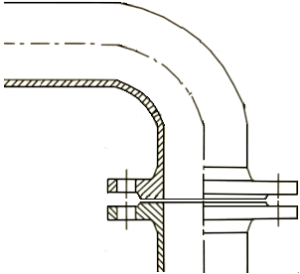
Figura 1

Escoamento em um duto com curva de 90°

Agora vamos fazer uma análise de um fluido incompressível escoando em regime permanente através de duto com uma curva de 90°, considerando efeitos hidrodinâmicos, térmicos e estruturais. O sistema consiste em um duto horizontal com flange rígido na entrada e junta de expansão na saída.
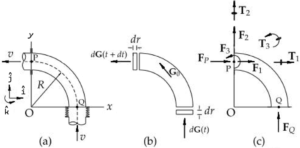
Figura 2

1. Definição do Problema

  • Fluido incompressível: Massa específica \(\rho\)=constante em regime isotérmico.

  • Regime permanente: As propriedades do escoamento não variam no tempo.

  • Velocidade uniforme \(v\): A velocidade é a mesma na entrada e na saída (assumindo área transversal constante).

  • Plano horizontal: Forças gravitacionais são desprezíveis.

  • Junta de expansão: Não transmite esforços (livre para se mover).

  • Flange rígido: Transmite todos os esforços para a estrutura.

2. Equações

2.1. Conservação da Massa:

\begin{equation}
\int \rho \vec{v} d \vec{A} = \rho A (\vec{v_e} – \vec{v_s}) = 0
\end{equation}

2.2. Conservação da Quantidade de Movimento Linear:

A equação integral da conservação da quantidade de movimento para um volume de controle (VC) fixo é:

\begin{equation}
\sum \vec{F} = \int_{VC} \rho \vec{v} (\vec{v} \cdot \vec{n}) d \vec{A} = \dot{m}(\vec{v_e} – \vec{v_s})
\end{equation}

Onde:

\(\sum \vec{F}\): Forças externas atuando no \(VC\) (pressão e reação no flange).
\(\vec{F}\): Vetor velocidade.
\(\vec{n}\): Vetor normal à superfície de controle (apontando para fora).
\(\dot{m}=\rho v A\): Vazão mássica
\(\vec{v_e} ​= v_e \hat{i}\) e \(\vec{v_s} ​= v_s \hat{j}\): Velocidades na entrada e saída.

A força exercida pelo fluido no duto (ação) é: 

\(\vec{R}_{flange} = \dot{m}(\vec{v_e} – \vec{v_s}) + (p_e ​A \hat{i} + p_s ​A \hat{j})\)

Se \(p_e=p_s=p\) e \(v_e = v_s = v\)

\(\vec{R}_{flange} = \rho v A(v\hat{i} – v\hat{j}) + (pA \hat{i} + p​A \hat{j})\)

\(\vec{R}_{flange} = \rho v^2 A(\hat{i} – \hat{j}) + pA(\hat{i} + \hat{j})\)

A força resultante no flange é:

\[
\boxed{\vec{R}_{flange} = – (\rho v^2 + p ) A (\hat{i} + \hat{j})}
\]

2.3. Caso com Variação de Área ou Velocidade

Se a área da seção transversal mudar (\(A_e \ne A_s\)​), a velocidade também muda (\(v_e A_e=v_s A_s\)), por continuidade). A equação de Bernoulli pode ser usada para relacionar pressões:

\begin{equation}
p_e + \frac{1}{2+}\rho {v_e}^2 =p_s + \frac{1}{2+}\rho {v_s}^2 +\Delta_{perdas​}
\end{equation}

Onde \(\Delta p_{perdas​}$ são perdas por atrito e turbulência.

Forças resultantes atualizadas:

\(R_x = \rho {v_e}^2 A_e −p_e A_e\)

\(R_y=\rho {v_s}^2 A_s −p_s A_s\)

Aplicação Prática: Dimensionamento do Flange
Para garantir a resistência do flange, um engenheiro deve considerar:

Força estática máxima:

\(R_{max} = \rho v^2 A + p A\)    (considerando pressão e velocidade máximas operacionais).

1. Fator de segurança: Multiplicar \(R_{max}\) por um coeficiente.
2. Material e parafusos: O flange deve ser fabricado com material resistente (aço carbono, aço inox) e os parafusos devem ser dimensionados para suportar a carga.
3. Vibrações e fadiga: Se o escoamento for pulsante, deve-se avaliar efeitos dinâmicos.


3. Conservação do Momento Angular

3.1. Momento Torsor (Torque) no Flange

Além da força resultante, a curva pode induzir um momento torsor no flange devido à distribuição assimétrica de pressões e velocidades. 

A equação integral para o momento angular é:

\begin{equation}
\sum \vec{M}_{ext} = \int \rho (\vec{r} \times\vec{v})(\vec{v}\cdot d \vec{A})
\end{equation}

  • Para uma curva simétrica e flange rígido:

Como o escoamento é simétrico e o flange está rigidamente fixado, o torque líquido no flange é zero em condições ideais. Porém, em situações reais (escoamento turbulento, assimetrias), pode haver um pequeno torque residual.

Entrada: Momento angular \(-\rho r v^2A \hat{k}\).
Saída: Momento angular \(+\rho r v^2 A \hat{k}\).

Assim:

\begin{equation}
\sum \vec{M}_ext = \int \rho (\vec{r} \times\vec{v})(\vec{v}\cdot d \vec{A} = 0
\end{equation}

\[
\boxed{\vec{T} = 0}
\]

  • Com assimetria (ex.: junta excêntrica em z):

O torque \(\vec{T}\) em relação ao centro da curva é dado por:

\begin{equation}
\vec{T} = \vec{r_e}\vec{F_e} \times \vec{r_s}\vec{F_s}
\end{equation}

​Onde:

 \(\vec{r_e}\) e \(\vec{r_e}\) são vetores posição dos pontos de aplicação das forças.
\(\vec{F_s}​\) e \(\vec{F_s}\) são as forças de pressão e quantidade de movimento nas seções de entrada e saída.

Torque no flange:

\[
\boxed{\vec{T}= – (\rho v^2 + p) r A \hat{k}}
\]

onde \(r\) é a distância do centro de curvatura ao ponto de aplicação da força.

4. Ajustes para Cenários Reais

Perdas por Atrito e Queda de Pressão

Em sistemas reais, o atrito entre o fluido e as paredes do duto causa perdas de energia, levando a uma queda de pressão ( \(\Delta p\) ). Isso pode ser modelado pela equação de Darcy-Weisbach ou por correlações empíricas.

Equação de Darcy-Weisbach:

\begin{equation}
\Delta p = f \frac{L}{D} \frac{\rho v^2}{2}
\end{equation}

Onde:

\(f\): Fator de atrito (depende do regime de escoamento e rugosidade da parede).
\(L\): Comprimento da curva ou trecho analisado.
\(D\): Diâmetro hidráulico do duto.

Impacto no modelo:

A pressão na saída (\(p_s\)​) será menor que na entrada (\(p_e\)​):

\(p_s = p_e – \Delta p\)

A força resultante no flange deve incluir essa diferença:

\[
\boxed{\vec{F}_{flange} = -[(\rho v^2+p_e)A \hat{i} +(\rho v^2+p_s)A \hat{j}]}
\]

Distribuição Não Uniforme de Pressão

Em curvas reais, a pressão não é constante ao longo da seção transversal devido a efeitos centrífugos:

Parede externa: Pressão mais alta.
Parede interna: Pressão mais baixa (efeito de sucção).

Modelo para Pressão Assimétrica:
A pressão pode ser aproximada por uma distribuição parabólica:

\begin{equation} p (\theta) = p_{avg} + \Delta p_{max} cos (2 \theta) \end{equation}

Onde:

\(\theta\): Ângulo ao longo da curva (0° a 90°).

\(\Delta p_{max​}\): Diferença máxima de pressão (empiricamente determinada).

A força de pressão agora requer uma integração angular:

\begin{equation}
\vec{F}_p=\int_{0}^{\pi/2} p (\theta) \cdot \vec{n} (\theta) r d\theta
\end{equation}

Isso pode introduzir torques adicionais se a distribuição não for simétrica.

Turbulência e Vórtices

– Escoamentos reais em curvas geram vórtices secundários e turbulência, que:

– Aumentam as perdas de energia.Podem causar vibrações no duto e no flange.

Modelagem via Número de Reynolds (\(Re$):
\begin{equation}
Re=\frac{\rho v D}{\mu}
\end{equation}

Se \(Re> 4000\) escoamento é turbulento, e o fator de atrito \(f\) deve ser ajustado (usando, por exemplo, o diagrama de Moody).

Variação de Área ou Velocidade

Se o duto tem áreas diferentes na entrada ( \(A_e\) ) e saída (\(A_s\)​), a velocidade muda (\(v_e A_e = v_s A_s\)), afetando o balanço de momento.

  1. Conservação da massa com áreas diferentes: 

    \( v_s = v_e \frac{A_e}{A_s}\)

  2. Força no flange:

    Conservação da massa com áreas diferentes: \( v_2 = v_1 \frac{A1}{A2} \)

    Força resultante atualizada:

    \begin{equation} \vec{F} = -[(\rho {v_1}^2 + p_1)A_1 \hat{i} + (\rho {v_2}^2 + p_2)A_2 \hat{j}] \end{equation}

Efeitos Dinâmicos Transiente

Em cenários como fechamento de válvulas ou partida do sistema, forças adicionais surgem devido a acelerações do fluido.

Equação de Momentum Transiente:

\begin{equation} \vec{F}_{inercia} = \rho L A \frac{\vec{F}}{dt} \end{equation}

: Comprimento característico do duto.

\(\frac{dv}{dt}\): Aceleração do fluido.

Variação das Propriedades do Fluido com a Temperatura

Para líquidos (ex.: água, óleo) e gases (ex.: ar, vapor), \(\rho\) e \(\mu\) dependem da temperatura (\(T\)):

  • Líquidos:

\(\rho (T)= \rho_0[1 – \beta(T – T_0)]\),   \(\mu(T) \propto e^{-k(T – T_0)}\)

(\(\beta\) = coeficiente de expansão térmica, \(k\) = constante empírica).

  • Gases (lei dos gases ideais):

\begin{equation} \rho(T)=\frac{p}{RT} \end{equation}

\(\mu (T) \propto T^{0.7}\)

Dilatação Térmica do Duto

O material do duto (aço, PVC, etc.) expande-se com a temperatura:

\begin{equation} \Delta L=\alpha L \Delta T \end{equation}

 = coeficiente de dilatação térmica.

Critério de falha:

Tensão térmica:

\(\sigma_{termico} = E \alpha \Delta T\)

Se \(\sigma_{termico} > \sigma_{adm}\)​, há risco de trincas ou vazamentos.

Convecção Natural

Número de Grashof:

\begin{equation} Gr = \frac{g\beta \Delta T L^3}{\nu} \end{equation}

Força e Torque com Efeitos Térmicos

Força no flange:

\begin{equation} \vec{F} = -[(\rho(T) v^2 + p(T))A](\hat{i}+ \hat{j)} \end{equation}

Torque térmico:

\begin{equation} \vec{T}_{termico} = \int r \times (\alpha E \Delta T)d \end{equation}

Recomendações para Projeto

Para escoamento:

Use CFD para simular distribuição de pressão e turbulência.

Adote um fator de segurança de 20-50 % nas forças calculadas.

Para efeitos térmicos:

Materiais com baixo \(\alpha\) (ex.: aço inox).

Juntas de expansão termicamente isoladas.

Para transientes:

Amortecedores de pressão para golpes de aríete.

Equações-Chave Resumidas:

Fenômeno Equação
Força no flange \(\vec{F} = – (\rho v^2 + p) A (\hat{i} + \hat{j})\)
Torque \(\vec{T} =- (\rho v^2 + p) r A \hat{k}\)
Perda de pressão \(\Delta p=f \frac{L}{D} \frac{\rho v^2}{2}\)
Dilatação térmica \(\Delta L = \alpha L \Delta T\)
Tensão térmica \(\sigma = E \alpha \Delta T\)

Este modelo integrado permite dimensionar sistemas reais com segurança, considerando desde escoamento ideal até efeitos térmicos e estruturais complexos.
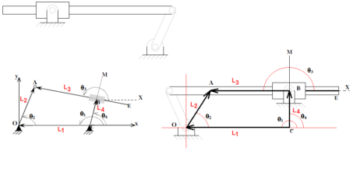
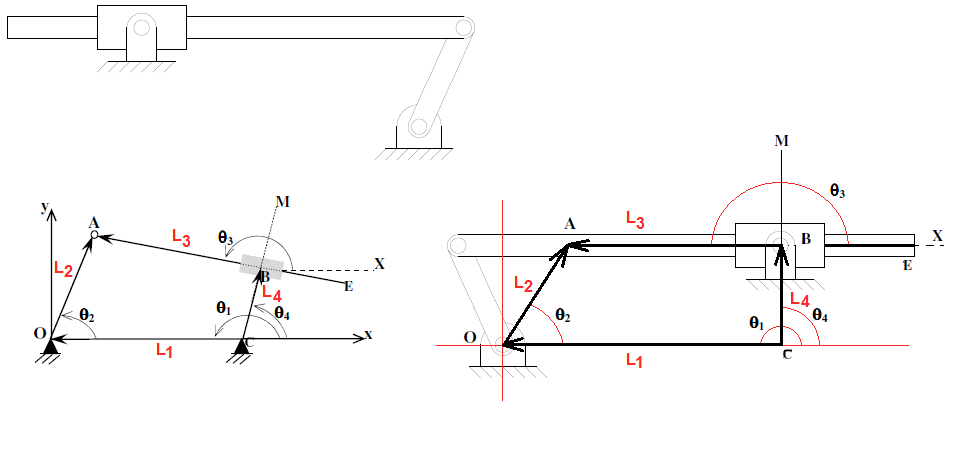
 

Mecanismo de 4 barras


Formulação

O ângulo \(\theta_1\) é igual a 180º, o ângulo entre \(BA\) e \(CB\) é de 90º. \(\theta_2\) é o ângulo entre os vetores \(OA\) e \(CO\) e representa um dado de entrada. A soma dos ângulos no ponto B é: \(\theta_3\) + (180º – \(\theta_4\)) + 90º = 360º, então \(\theta_3\) = 90º + \(\theta_4\).


O polígono formado pelos vetores na Figura 1 pode ser descrito por:

\begin{equation} \label{eq:q_b1} CO + OA = CB + BA \rightarrow CO + OA – CB – BA = 0 \end{equation}

Decompondo Eq. (??), torna-se:

\begin{equation} \label{eq:q_b2} L_1cos \theta_1 + L_2cos \theta_2 – L_3cos \theta_3 – L_4cos \theta_4 = 0 \end{equation} \begin{equation} \label{eq:q_b3} L_1sin\theta_1 + L_2sin \theta_2 – L_3sin \theta_3 – L_4sin \theta_4 = 0 \end{equation}

Substituindo \(\theta_1\) e \(\theta_3\), temos:

\begin{equation} \label{eq:q_b4} -L_1 + L_2cos \theta_2 + L_3sin\theta_4 – L_4cos \theta_4 = 0 \end{equation} \begin{equation} \label{eq:q_b5} L_2sin \theta_2 – L_3cos \theta_4 – L_4sin \theta_4 = 0 \end{equation}

O valor de \(L_3\) vem da Eq. (??) em função dos dados de entrada \(\theta_2\), \(L_2\) e \(L_4\):

\begin{equation} \label{eq:q_b6} L_3 = \frac{L_2sin \theta_2 – L_4sin \theta_4}{cos \theta_4} \end{equation}

Substituindo a Eq. (??) na Eq. (??):

\begin{equation} \label{eq:q_b7} -L_1 + L_2cos\theta_2 + \left(\frac{L_2sin \theta_2 – L_4sin \theta_4}{cos \theta_4}\right)sin\theta_4 – L_4cos \theta_4 = 0 \end{equation}

Simplificando, temos:

\begin{equation} \label{eq:q_b8} (L_2sin \theta_2 – L_1)cos\theta_4 + L_2cos\theta_2sin\theta_4 – L_4 = 0 \end{equation}

O ângulo \(\theta_4\) é determinado considerando os seguintes relações trigonométricas na Eq. (??):

\begin{equation} \nonumber cos\theta_4 = \frac{ 1 – tan^2 \left(\frac{\theta_4}{2}\right)}{1 + tan^2 \left(\frac{\theta_4}{2}\right)} \end{equation} \begin{equation} \nonumber sin\theta_4 = \frac{ 2tan^2 \left(\frac{\theta_4}{2}\right)}{1 + tan^2 \left(\frac{\theta_4}{2}\right)} \end{equation} \begin{equation} \label{eq:q_b9} (L_2sin \theta_2 – L_1)\frac{ 1 – tan^2 \left(\frac{\theta_4}{2}\right)}{1 + tan^2 \left(\frac{\theta_4}{2}\right)} + L_2cos\theta_2\frac{ 2tan^2 \left(\frac{\theta_4}{2}\right)}{1 + tan^2 \left(\frac{\theta_4}{2}\right)} – L_4= 0 \end{equation}

Simplificando, teremos:

\begin{equation} \label{eq:q_b10} (L_1 – L_2cos\theta_2 – L_4)tan^2\left(\frac{\theta_4}{2}\right) + (2L_2sin\theta_2)tan\left(\frac{\theta_4}{2}\right) +(L_2cos\theta_2 – L_1 – L_4) = 0 \end{equation}

Os coeficientes do polinômio do segundo grau da Eq. (??) são:

\(A = (L_1 – L_2cos\theta_2 – L_4)\)

\(B = (2L_2sin\theta_2)\)

\(C = (L_2cos\theta_2 – L_1 – L_4) = 0\)

Então \(\theta_4\) é dado por:

\begin{equation} \theta_4 = \pm 2tan^{-1}\left(\frac{-B \pm \sqrt{B^2 – 4AC}}{2A}\right) \end{equation}