
Formulação
O ângulo \(\theta_1\) é igual a 180º, o ângulo entre \(BA\) e \(CB\) é de 90º. \(\theta_2\) é o ângulo entre os vetores \(OA\) e \(CO\) e representa um dado de entrada. A soma dos ângulos no ponto B é: \(\theta_3\) + (180º – \(\theta_4\)) + 90º = 360º, então \(\theta_3\) = 90º + \(\theta_4\).
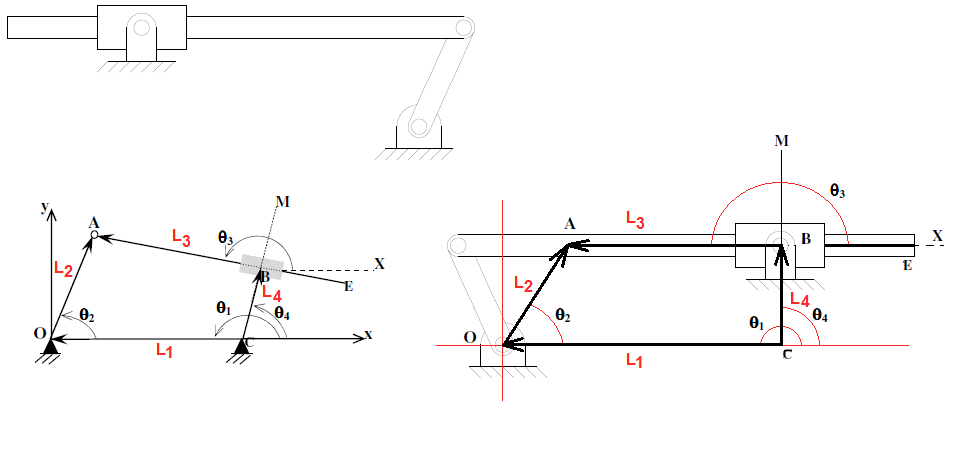
O polígono formado pelos vetores na Figura 1 pode ser descrito por:
\begin{equation} \label{eq:q_b1} CO + OA = CB + BA \rightarrow CO + OA – CB – BA = 0 \end{equation}
Decompondo Eq. (??), torna-se:
\begin{equation} \label{eq:q_b2} L_1cos \theta_1 + L_2cos \theta_2 – L_3cos \theta_3 – L_4cos \theta_4 = 0 \end{equation} \begin{equation} \label{eq:q_b3} L_1sin\theta_1 + L_2sin \theta_2 – L_3sin \theta_3 – L_4sin \theta_4 = 0 \end{equation}
Substituindo \(\theta_1\) e \(\theta_3\), temos:
\begin{equation} \label{eq:q_b4} -L_1 + L_2cos \theta_2 + L_3sin\theta_4 – L_4cos \theta_4 = 0 \end{equation} \begin{equation} \label{eq:q_b5} L_2sin \theta_2 – L_3cos \theta_4 – L_4sin \theta_4 = 0 \end{equation}
O valor de \(L_3\) vem da Eq. (??) em função dos dados de entrada \(\theta_2\), \(L_2\) e \(L_4\):
\begin{equation} \label{eq:q_b6} L_3 = \frac{L_2sin \theta_2 – L_4sin \theta_4}{cos \theta_4} \end{equation}
Substituindo a Eq. (??) na Eq. (??):
\begin{equation} \label{eq:q_b7} -L_1 + L_2cos\theta_2 + \left(\frac{L_2sin \theta_2 – L_4sin \theta_4}{cos \theta_4}\right)sin\theta_4 – L_4cos \theta_4 = 0 \end{equation}
Simplificando, temos:
\begin{equation} \label{eq:q_b8} (L_2sin \theta_2 – L_1)cos\theta_4 + L_2cos\theta_2sin\theta_4 – L_4 = 0 \end{equation}
O ângulo \(\theta_4\) é determinado considerando os seguintes relações trigonométricas na Eq. (??):
\begin{equation} \nonumber cos\theta_4 = \frac{ 1 – tan^2 \left(\frac{\theta_4}{2}\right)}{1 + tan^2 \left(\frac{\theta_4}{2}\right)} \end{equation} \begin{equation} \nonumber sin\theta_4 = \frac{ 2tan^2 \left(\frac{\theta_4}{2}\right)}{1 + tan^2 \left(\frac{\theta_4}{2}\right)} \end{equation} \begin{equation} \label{eq:q_b9} (L_2sin \theta_2 – L_1)\frac{ 1 – tan^2 \left(\frac{\theta_4}{2}\right)}{1 + tan^2 \left(\frac{\theta_4}{2}\right)} + L_2cos\theta_2\frac{ 2tan^2 \left(\frac{\theta_4}{2}\right)}{1 + tan^2 \left(\frac{\theta_4}{2}\right)} – L_4= 0 \end{equation}
Simplificando, teremos:
\begin{equation} \label{eq:q_b10} (L_1 – L_2cos\theta_2 – L_4)tan^2\left(\frac{\theta_4}{2}\right) + (2L_2sin\theta_2)tan\left(\frac{\theta_4}{2}\right) +(L_2cos\theta_2 – L_1 – L_4) = 0 \end{equation}
Os coeficientes do polinômio do segundo grau da Eq. (??) são:
\(A = (L_1 – L_2cos\theta_2 – L_4)\)
\(B = (2L_2sin\theta_2)\)
\(C = (L_2cos\theta_2 – L_1 – L_4) = 0\)
Então \(\theta_4\) é dado por:
\begin{equation} \theta_4 = \pm 2tan^{-1}\left(\frac{-B \pm \sqrt{B^2 – 4AC}}{2A}\right) \end{equation}